


PAINTING BY NUMBERS

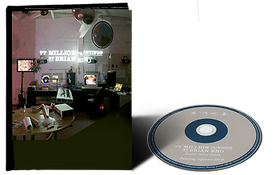
" 77M is a compound painting, generated by your computer using especially developed software to permutate
Eno’s originals."
The audio is processed in a similar way, combining layers of sound, ensuring you never hear exactly the same thing twice, even if running 24 hours a day, 365 days of the year. The title 77 Million Paintings reflects the possible permutations of the piece. This is a slowly shifting piece which can move as slowly as a clock with barely observable transitions. This allows it to be seen as a stiller and more traditional painterly piece, albeit evolving and living in time.
The result is a beautiful and serene work which encourages us to re-assess the role of the screens we use as well as how and where we experience art.
77 Million Paintings explores a different idea of what we consider an ‘original’. If traditionally an original piece is unique as an object, 77 Million Paintings uses the uniqueness of a passing moment which has almost certainly never existed before. It is a configuration of elements which settles before moving on to something else. Every user will buy exactly the same pack of ‘seeds’ but they will all grow in different ways and into distinct paintings, the vast majority of which the artist himself has not even seen. Random permutation determines the life of this piece as we watch it unfold.
The original in art is no longer solely bound up in the physical object, but rather in the way the piece lives and grows. It is moving in time and each moment is an original. As a fluid fusion of traditional painting techniques and computer coding, this is truly painting by numbers.
" 77 Million Paintings is a canvas
which holds a living painting."
This is the next evolutionary stage of Brian Eno’s exploration into light as an artist’s medium and the aesthetic possibilities of ‘generative engines’. This piece utilises the computer’s unique capacity as a generating processor to produce original visual compounds out of a large quantity of hand-painted elements.
One way to understand this idea is to imagine that you have a large box full of painted components and you are allowed to blindly take out between one and four of these at any time and overlay them to make a composite painting. The selection of the elements and their duration in the painting is variable and arbitrarily determined.


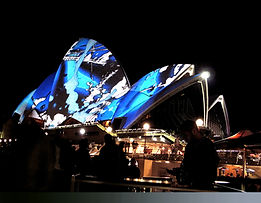
LUMINESCENCE • Exhbiting 77Million Paintings
77 Million Paintings was originally intended to be an at-home version of the visual and sonic installations that Brian Eno had been presenting in public spaces for the previous twenty years. It was a response to the challenge of making something that was able to be a stand-alone experience of high quality - not just a documentation of the gallery installations which had inspired it.
The challenge had been this: how can we make Eno’s visual work available to a wider audience, beyond those who are able to visit his installations? The most obvious answer was to film the installations and produce a DVD for home viewing, but this was an unsatisfactory solution for a number of reasons. Firstly, the intensity of the light and the sense of presence the pieces create renders them difficult to film, and watching such films produces little of the feeling of being immersed in the work. Secondly, a linear film can only document a brief period in the life of these generative pieces: it is not itself generative. The work is designed to keep creating unique juxtapositions without repeating, something a film clearly couldn’t do.
Software was the natural solution as we could then design the code to emulate what Eno had been doing with projectors. This then became a piece of live, self-generating art rather than a recording. 77 Million was released as a software CD-Rom in 2005 for home use on domestic computers.
The process, however, did not stop here. We had received invitations to show the 77 Million Paintings software in public spaces, and we began to wonder what would happen if we were to reintroduce this new generative painting back into a gallery. From March 2006, we were invited to exhibit the piece – over many monitors - in galleries around the world including the Milan Triennale and the Venice Biennale.
We thought of monitors as sculptural elements and designed configurations , or ‘clusters’ to be hung in a gallery space and to utilise symmetry by splitting the image signals and breaking the conventional shapes of a screen. The resulting effect is rather like sitting in front of an enormous and gently moving, secular stained glass window. It is a piece that slows the observer down to its own speed and people often stay for unexpectedly long periods – even several hours. It seems there is a real social need for this sanctuary of immersive calm in a busy city.
The next experiment was to project the piece over entire architectural structures in an attempt to turn buildings into a ‘breathing’ presence. This happened most notably with The Sydney Opera house in 2009 and we were the first people to be invited to turn the entire building into an art work.
The cyclic nature of the piece took a further turn when it was re-introduced back into a domestic environment, this time in a customised unit, resembling the gallery clusters and using the same ideas of rotational symmetry. This became a domestic painting for the walls of your house.
Based on an original piece by Brian Eno.
Concieved and coordinated by Lumen London, founded by Nick Robertson and Dominic Norman-Taylor.
Developed by Brian Eno, Nick Robertson and Dominic Norman-Taylor in 2004-5.
Source paintings by Brian Eno.
Sofware Design and programming by Jake Dowie, Paul Collister, Peter Chilvers
Print Editions by Brian Eno & Nick Robertson.
The Monitor Paintings by Nick Robertson & Fred Fabre.
Exhibition Design by Nick Robertson, Brian Eno and Dominic Norman-Taylor.
Publicity, Product Design and Merchandise by. Nick Robertson.
[EXHIBITION LIST] 2006 - 2022
2022 • Italy Trento, Castel Beseno
2022 • Italy Trento, Castello del Buonconsiglio
2022 • Japan Kyoto, Former Kyoto Chuo Bank
2021 • Finland Helsinki, Musiikkitalo
2021 •. Austria Graz Dom Im Berg
2021 • UK Totnes, Old Dairy Crest Development
2019 •. Latvia Riga, Riga Art Space
2019 •. Greece Athens, Stavros Niarchos Foundation
2019 •. Ireland Dublin, Royal Hibernian Academy
2018 •. Azerbaijan Baku, Heydar Aliyev Cultural Center
2018 •. Bosnia & Herzegovina Sarajevo, History Museum of Bosnia & Herzegovina
2018 •. Germany Berlin, Martin Gropius Bau Empty Formalism
2017 •. Spain Barcelona, Arts Santa Monica
2016/7 •. Argentina Buenos, Aires Kirchner Cultural Center
2016 •. UK Macclesfield, Lovell Telescope, Jodrell Bank
2016 • UK Brighton, Macmillan Centre
2016 •. Italy Mantova, Palazzo Te
2016 • UK London, Chelsea & Westminster Hospital
2016 •. UK London, Science Museum Music for ‘Otherworlds’
2015 •. Sweden Huddinge, Kasta School
2015 •. Italy Bari, Teatro Margherita
2014 •. UK Hove, Montefiore Hospital
2013 •. Spain Madrid, Sala de Exposiciones
2013 •. Netherlands Endoven, The Temporary Arts Centre Introducing Time in Design
2012 •. Brazil Rio de Janeiro, Arcos da Lapa
2012 •. USA New York, Cafe Rouge Temporary Space
2012 •. Norway Kristiansand, Kilden Arts Centre Festival Curation
2012 •. Italy Venaria, Reale Palace of Venaria
2011 •. USA Asheville, YMI Cultural Center
2011 •. Poland Wroclaw, Centennial Hall
2011 •. Canada Calgary, Glenbow Museum
2010 •. Russia St Petersburg, YOTA Temporary Space
2010 •. Mexico Mexico City, Anahuacalli
2010 •. UK Brighton, Fabrica
2010 •. UK Brighton, Marborough House
2010 •. UK Brighton Brighton, Dome Brighton Festival curation
2009 •. USA Long Beach, UAM
2009 • USA San Francisco, University of
2009 •. Australia Sydney, Sydney Opera House 77 Million Paintings (Projection on sails) & Festival Curation
2009 •. Australia Sydney, The Studio, Sydney Opera House
2009 •. Italy Rome, Pallazzo Ruspoli
2008 •. UAE Abu Dhabi, Temporary Space
2008 •. Italy Naples, Madre
2008 •. Norway Kristiansand, Sorelandets Kunstmuseum
2008 •. Belgium Brussels, BOZAR
2008 • Austria Wattens, Swarovski Gallery
2008 •. Canada London, Ontario Museum London
2007 •. USA San Francisco, Yerba Buena Centre for the Arts
2007 •. Italy Naples, Grotta di Selano
2007 •. Spain Zaragoza, Centre for Contemporary Arts
2007 •. Spain Palma de Mallorca, Teatre Principal
2007 •. Spain Barcelona, FNAC Gallery
2007 •. South Africa Cape Town, Michaelis Gallery
2007 •. UK Gateshead, Baltic Centre
2007 •. UK London, Ultralounge at Selfridges
2006 •. Italy Venice, Spazio Cisterne, Arsenale
2006 •. UK Eastnor Castle, The Big Chill Festival
2006 •. UK London, Barbican
2006 •. Japan Tokyo, La Foret Museum, Harajuku